
BC.Game built much of its reputation on provably fair Originals, and every serious alternative copies the same trick. The useful part for you is that the honesty of any single round is something you can confirm on your own screen, with no coding and no faith in a licence. Set aside three minutes, and this walkthrough turns the cryptography into a checklist you can run at Wild.io, Rollbit, Roobet or BC.Game itself.
The commitment trick, in one paragraph
Strip away the jargon and provably fair is a promise the casino cannot quietly break. The site typically decides the raw result of your bet in advance, locks that decision inside a code it publishes before you play, and only reveals the raw ingredient afterwards, because the order of those steps is what removes the wiggle room. Because the published code would change if the ingredient changed, the operator is trapped: it either shows you the exact value it committed to, or the numbers stop matching and the cheating is obvious. Your job is simply to catch a mismatch, and mismatches are usually easy to spot.
The three inputs you are checking
Every verifiable round is built from three values, and knowing which one the casino controls is the whole game.
| Input | Who sets it | Why it matters |
|---|---|---|
| Server seed | The casino, kept hidden during play | The one value that could be rigged, so the one you audit |
| Client seed | You, editable at any time | Change it so nobody can claim the site chose a convenient pairing |
| Nonce | Automatic, +1 per bet | Gives every round on a seed pair its own unique fingerprint |
The server seed arrives wrapped. Before your first spin, the casino publishes a SHA-256 hash of it, a 64-character fingerprint that flows one way only. Nobody can reverse the fingerprint back into the seed, yet altering a single character of the seed would rewrite the fingerprint entirely. That published fingerprint is the casino's binding signature.
Running the check on a live account
The steps below are deliberately in the order you would actually do them at the cashier, not in theory.
- Before betting, open the Fairness or Provably Fair panel and copy the hashed server seed into a notes app. This is the commitment you will hold the casino to.
- Overwrite the default client seed with any phrase of your own. A default seed is not proof of anything, so although the step looks trivial, it matters.
- Bet a few rounds and, if you want to audit one specific result, jot down its nonce as it climbs.
- Rotate to a fresh server seed. Rotation is what unlocks the old one, and only now does the casino hand you its plain-text value.
- Paste that plain seed into any offline SHA-256 calculator. If the fingerprint it produces is byte-for-byte the hash from step one, the seed was fixed before you ever bet. A difference of even one character means stop, screenshot, and leave.
- For total certainty, feed the plain seed, your client seed and the nonce into the game's published formula, or an open verifier for that engine, and confirm the number it returns is what the screen showed you.
A Limbo round, verified end to end
Numbers make it click, so here is a real-shaped example on Limbo. Before you started, the casino committed to the hash 7c4d...e18. You changed your client seed to bcg-check-01, played five rounds, then rotated the seed and received the plain server seed d90a...5bb.
You run d90a...5bb through a SHA-256 tool. Out comes 7c4d...e18, an exact match, which proves the seed was sealed before your first bet. Now you take that seed, your bcg-check-01, and nonce 4 for the fifth round, push them through the Limbo formula, and it returns a target multiplier of 2.07x. That is precisely what busted on screen. One confirmed round is all it takes to trust the mechanism rather than the marketing.
Originals you can verify, and slots you cannot
Verification only reaches a casino's in-house games, not the third-party slot lobby. Slots from studios such as Pragmatic Play or Hacksaw typically lean on a certified RNG signed off by a lab such as GLI or iTech Labs, which is assurance of a different kind rather than something you personally recompute. The verifiable set is the familiar house family:
| Original | The bet in one line | Verifiable? |
|---|---|---|
| Limbo | Beat a target multiplier you set | Yes |
| Dice | Land over or under your chosen number | Yes |
| Crash | Cash out before the curve snaps | Yes |
| Mines | Flip safe tiles, dodge the bombs | Yes |
| Plinko | Drop the ball into a multiplier slot | Yes |
| Keno | Match your picks to the draw | Yes |
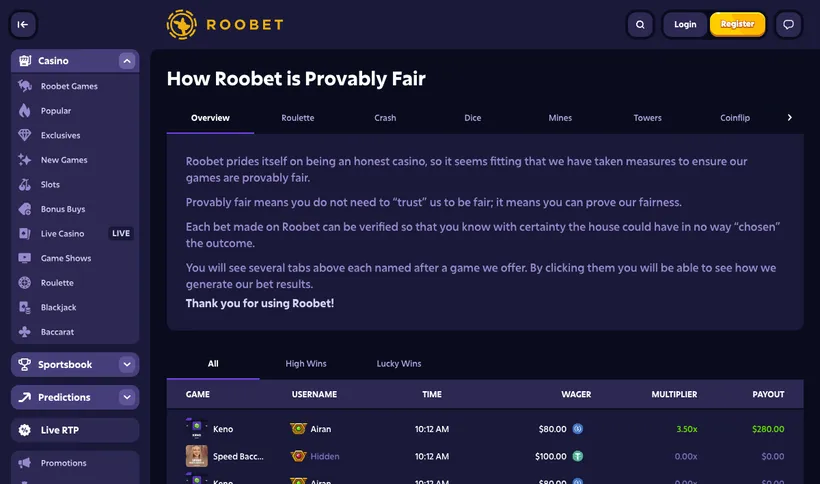
Among the brands ranked here, first-party verifiable Originals show up at Stake, BC.Game, Rollbit, Roobet, Wild.io and Shuffle. Aggregator sites often paste a "provably fair" badge onto a page that has no seed panel at all, so although the label reassures, treat it as a claim until you actually find the panel.
What a clean verification does not buy you
Here is the honest ceiling. Passing the check proves one thing only: the specific rounds you tested were not doctored after your bet. It stays silent, though, on whether a large withdrawal clears, whether the wagering on a bonus is survivable, or whether support replies when a dispute starts.
A casino can run mathematically spotless Originals and still park your five-figure cash-out behind a sudden KYC request. So bank provable fairness as one column in a wider ledger, because on its own it is narrow, sitting next to signals such as a real licence, a history of paying disputes, and a KYC threshold you understood before depositing. To see which BC.Game alternatives combine verifiable games with a solid payout record, the BC.Game alternatives ranking is the practical next step.
Provably fair FAQ
Does provable fairness stop a casino cheating you entirely?
No. It locks down the outcome of any round you verify, which is real, but it does nothing about a stalled withdrawal, a punishing wagering multiple, or a bonus max-bet clause used to void winnings. The maths guards the game, not the operator's conduct, so weigh licence and payout history alongside it.
How long does it take to verify one round?
A couple of minutes. Copying a hash, choosing a client seed and pasting the revealed seed into a SHA-256 checker is the bulk of it. For recomputing the result itself, open verifiers exist for the common Stake-engine games, so you almost never touch the raw formula.
Can you verify a slot the same way?
Usually not. Third-party slots run certified RNGs audited by labs such as GLI, iTech Labs or eCOGRA rather than a seed you inspect yourself. Personal verification is reserved for a casino's own Originals, such as Limbo, Dice, Crash, Mines, Plinko and Keno.